
Which ELN is best for my Lab in 2026? And why that's the wrong question to ask.
When looking into digital solutions for their lab, most scientists probably start thinking along the lines of “which ELN (Electronic Lab Notebook) should I get?”. Others might ask about LIMS (Laboratory Information Management Systems). Somewhere in their search, the idea of an integrated ELN / LIMS probably surfaces. But fundamentally, any search that lands there in 2026 has, respectfully, asked the wrong question.
When looking into digital solutions for their lab, most scientists probably start thinking along the lines of “which ELN (Electronic Lab Notebook) should I get?”. Others might ask about LIMS (Laboratory Information Management Systems). Somewhere in their search, the idea of an integrated ELN / LIMS probably surfaces. But fundamentally, any search that lands there in 2026 has, respectfully, asked the wrong question.
Instead, in a world of increasingly large datasets, complex experimental designs, increasing reagent costs, stagnating R&D budgets, and overwhelming choice when it comes to digital tools, why not go right back to basics instead, and ask “which digital lab management tool(s) will make my life easiest?”.
Of course, “easy” is a relative concept, and every lab has slightly different needs, but in this article, we’re comparing several well-known, and some lesser-known lab management solutions to try to understand which technologies will actually solve your lab’s digital dilemma, and which will just add another level of complication into already fragmented ways of working.
The Contenders: Benchling | Labguru (by Cenevo) | Lab Thread | SciNote | SciSure | Scispot
There are hundreds of blog posts and review sites that compare the features of different lab management tools, so in this article, we’re taking a slightly different approach, and instead, asking how each of these tools would help you, as either a bench scientist or senior management, navigate a series of real-world laboratory scenarios from in silico simulation to supporting project handover.
Question 1. How easy is it to actually use the software? And how long will it take until your lab is using it consistently?
If you’re considering a new lab software, this is the million dollar question. How easy is it to set up? How quick is it to get up to speed? How disruptive will it be to change your current ways of working?
SciNote, SciSure and Scispot are all generally well reviewed for ease of use, and speed of implementation. Lab Thread is a newer platform, but early reviews praise ease of use, intuitive set up and streamlined record keeping. On the other hand, both Benchling and Labguru users report a steep learning curve, difficulty with navigation (Labguru) and for some smaller teams, the need for IT support to help with set up (Benchling).

Question 2. Can your software make it easier for you to assemble the necessary figures for a presentation or publication?
This is a bit of a trick question, because we need to think about both data analysis and figure generation to answer it fully. Users can embed images and tables into an ELN style document in all the platforms. Benchling’s enterprise plan includes a proprietary analytical module that allows users to build bar charts, scatter plots, heatmaps and regression analyses inside the software. Lab Thread also enables data analysis and graphing, but via a different mechanism. In Lab Thread, users can open an Excel file directly within the ELN. They can then work with it exactly as they normally would, including all preserved logic and graph generation. Scispot’s AI enabled analytics also include some visualisation and graph building functionality.
However, Lab Thread is the only platform in this comparison with a dedicated freeform canvas for composing publication-ready figures within the ELN. The others all require tables, charts and images to be assembled within another program, such as Powerpoint, Illustrator or GraphPad Prism.

Question 3: Can you design and simulate experiments in silico before stepping into the lab?
Most molecular biology labs are probably subscribing to SnapGene as well as their ELN / LIMS platform. That’s (at least) two subscriptions, two regular payments and two disconnected software platforms. Once again, Lab Thread and Benchling pull ahead of the crowd here, with a linked molecular biology module that allows users to import DNA sequences, check alignments, design and simulate restriction digests, ligations and PCR reactions. Lab Thread also plans to introduce a “Lab Processes” module, which will automate volume and dilution calculations, and streamline recording of routine lab processes (for example cell culture). Not strictly experiment planning, but still useful to replace scribbled calculations on scraps of paper.

Question 4: How quickly can you find where every sample came from, and everything derived from it?
This is a fundamental feature of any LIMS product, so every platform can support this request. In fact, all the platforms currently under discussion offer integrated ELN / LIMS, which means they can also link samples to the experiments that created them. Benchling and Lab Thread go one step further. Their integrated molecular biology functionality means that they can include links to the original molecular design, cloning strategies and, in the case of Lab Thread, even notes and annotations attached to the original DNA sequences - for example, which paper a particular sequence was detailed in.

Question 5: How much would your digital records help a new team member to pick up a project mid way through?
The frontrunners here are Benchling, Lab Thread and Scispot. Benchling and Scispot allow buildout of a complete digital record, with integrated lineage tracing, inventory and ELN to support research continuity. Lab Thread adds organisation of your research around a central project file, keeping all your plans, experiments, records, analysis and samples connected, and providing a complete “history” of your research.
Labguru and SciSure provide some support for new team members, with integrated ELN / LIMS functionality that connects each experiment to the samples it used, and links related samples. However, while SciNote’s ELN will give a new team member a starting point, there is no native connection to molecular design or sample lineage, so how helpful the record is will depend entirely on the level of detail included by the previous scientist.

Summary
With its focus on real life lab scenarios, this post has deliberately skirted an important consideration for any lab looking for a robust data management system, and that is, of course, what it will cost. This is not a deliberate omission, but the lack of pricing transparency in this area makes an accurate comparison challenging. In fact, Lab Thread is the only company in this comparison to publish its pricing plans. Academic pricing starts from free (including sequence viewing, ELN and project management functionality), with paid plans scaling from £22 - £67 per user per month when billed annually, depending on required functionality. Industry plans also scale with functionality, from £50 - £92 per user per month. While we cannot say for sure, because none of their pricing is public, we believe this compares favourably with other platforms, some of which, Benchling in particular, are reported to carry significant implementation costs on top of the base subscription fee.
We all know there’s no such thing as “easy” when it comes to life in the lab, but I am of the firm opinion that your science is complicated enough. Your record keeping (and budgeting) shouldn’t be more so.
And in the name of keeping life easy, here's a quick visual summary of the discussion above:
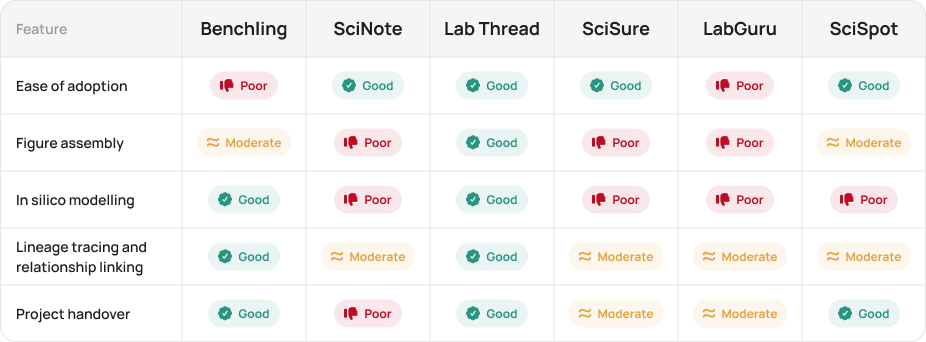
Capabilities reviewed June 2026. Lab Thread launched commercially in April 2026, refined from a beta launch in December 2025.
Discover how Lab Thread keeps data management simple.