Do I need an ELN, a LIMS or both? Here’s how to actually decide.
Electronic lab notebooks (ELN) are the digital entry point for most research labs. At their most basic, ELNs replace the paper notebook to provide a permanent, searchable, timestamped record of what was done, when, and by whom. But good ELN software does more than that. It structures data capture so that records are consistent across the team, supports review and approval workflows, and provides the audit trail that underpins both reproducibility and regulatory compliance. Ultimately, it should make scientists' lives easier, without adding friction to their workflow or significant overhead to their budget. For most labs, it's the first and most important investment in digital infrastructure.
The question of whether you need a LIMS is a different and considerably trickier one; not because it's harder to answer, but because "LIMS" means very different things depending on who you ask. A laboratory information management system can refer to anything from a basic sample tracking tool to a fully validated GMP platform capable of supporting a regulatory submission, and receiving automated data transfer from laboratory equipment. Most labs searching for a LIMS are somewhere in the middle, and choosing the wrong level of system can be a costly mistake.
There's also a third option that's increasingly relevant for research labs: an integrated platform that combines ELN and LIMS functionality within a single connected workflow. Whether that's the right choice, or whether standalone tools serve you better, depends entirely on what you need each system to do.
So, what are the different types of LIMS? And which one should you choose? The table below outlines the different capabilities a LIMS platform may offer, and who is most likely to need them.
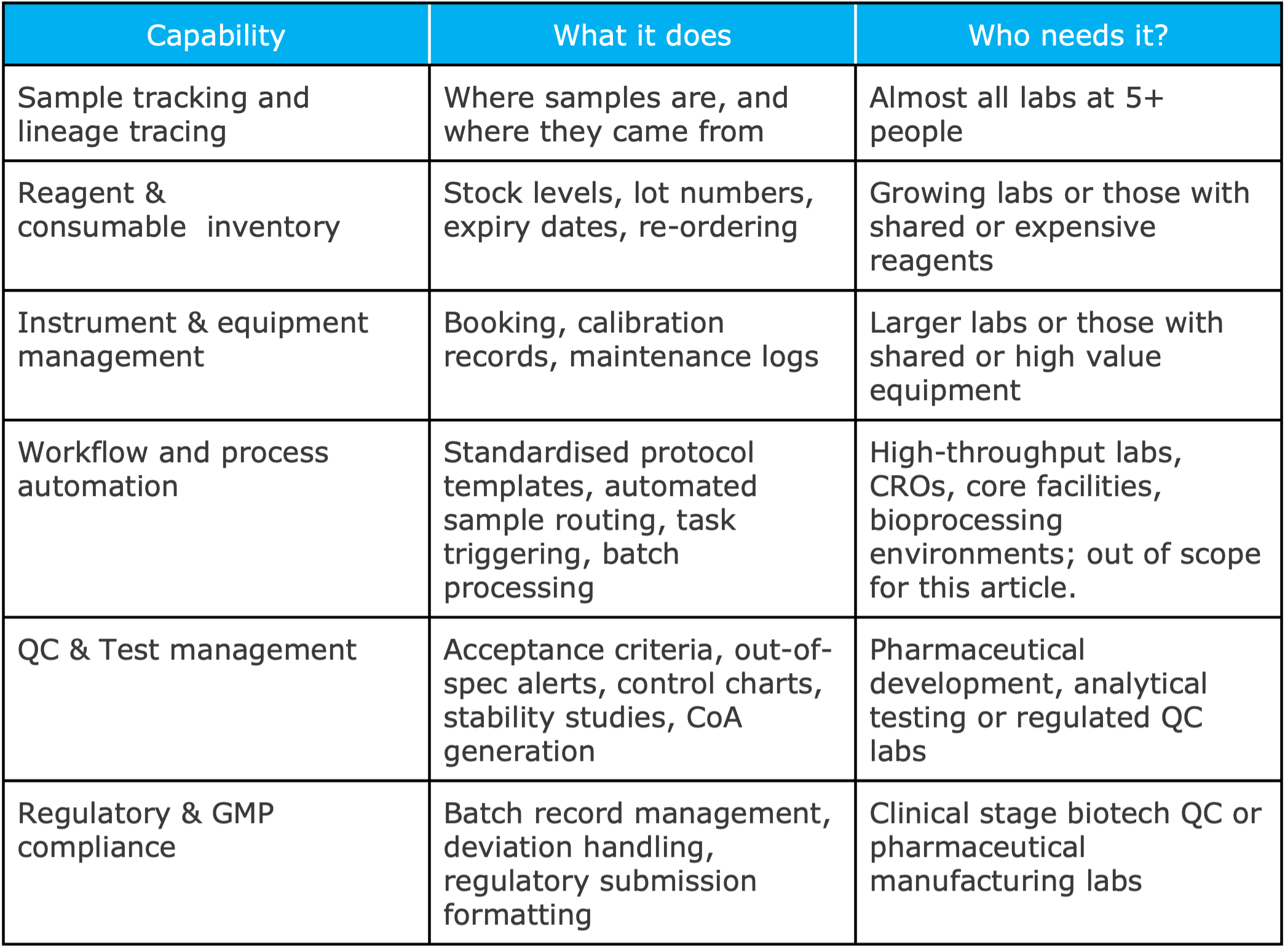
Which of these capabilities you require will depend on both the function and size of your lab. An over- or under- specified system is a costly mistake in both directions, so it pays to spend some time thinking through what your lab needs now, and what it’s likely to need in the next few years if it continues its current trajectory. In this article, we’ve broken down the most commonly considered LIMS capabilities and the different levels of functionality within them.
Sample Tracking
Basic: Most standalone LIMS systems can help you track what samples you have, where they are, and what their status is. This is a step up from a spreadsheet, but the sample information still exists in isolation. The system can tell you where your sample is, but nothing else about it.
Better: This is where an integrated ELN/LIMS has an advantage, because it can connect the sample to the experiment that created it. Now every sample exists together with information about what protocols were run, who ran them, and what the results were.
Best: The gold standard for sample tracking is full lineage tracing. This means keeping a fully traceable record of every sample, all the way from its molecular design to subsequent derivations. If we think of this in the context of a stable lentiviral producer cell line for example, this means a digital connection that runs from the original DNA sequence, the plasmid it was cloned into, the cell line it transfected, the vector it produced and the resulting clonal cell lines derived therefrom. Every branch of that tree, whether the DNA sequence is cloned into one plasmid or six, which transfects one cell line or three, resulting in one clonal cell line or several, and for however long the resulting cell lines are passaged, is fully traceable in both directions.
Summary
This is the most commonly required LIMS function, and the most important to get right for any lab whose research might eventually face a clinical trial, audit or due diligence process. Of all the categories, this is probably the one where you’ll never regret over-speccing for current needs.
Reagent & Consumable Inventory Management
Basic: Plenty of labs manage perfectly well with a manually updated shared spreadsheet of reagents and stock levels. This may only start to collapse when the lab grows and more people start drawing from shared stocks simultaneously, or when expensive reagents get used up faster than expected. But for most research groups, a simple system that lists out consumables and automatically calculates stock levels based on usage is likely enough of an upgrade.
Better: Biotech labs approaching Series B can likely start to feel the financial impact of mismanaging their inventory, which is where dedicated reagent management software comes into its own. These systems can track stock levels with lot numbers, expiry dates and location, and send alerts when stock levels reach a re-order threshold. Some systems can even integrate with supplier catalogues so that reordering can be done with a click.
Best: The most sophisticated inventory management systems offer full procurement integration, connecting directly to purchasing workflows, automated reorder triggers, supplier price comparisons, budget tracking and integration with Enterprise Resource Planning software. This level of functionality is predominantly relevant for large pharma operations, CDMOs or core facilities managing dozens of reagent lines across multiple projects. For the majority of research labs, the overhead and implementation of a system like this is not worth their while.
Summary
For most small biotech and academic labs, basic inventory management - whether manual, or within a standalone system - is sufficient. More sophisticated functionality is usually only worthwhile for bigger organisations with a large reagent spend.
Instrument & Equipment Management
Basic: Not every lab needs a digital system for this. For most groups, a shared calendar for the confocal microscope or flow cytometer is sufficient, even when multiple labs are sharing the same resource, but of course this doesn’t factor in equipment management or calibration records.
Better: Instrument maintenance logs and calibration records logged as part of the LIMS platform, with the system flagging when maintenance is due, reduces the risk of introducing a confounding variable into your data because the equipment wasn’t properly calibrated. Some integrated ELN / LIMS platforms can also link the equipment log to the ELN record, so that you have a digital record of which machine you ran each experiment on.
Best: Core facilities or large service organisations where instrument time is billable and downtime has a measurable cost may need more comprehensive equipment lifecycle management. This might include usage statistics, maintenance history, downtime tracking, cost per run analysis and even integration with service contracts.
Summary
For most labs, the most important aspect of equipment management is the maintenance and calibration record, with the ability to link equipment records to experimental data in the ELN a close second. Being able to manage equipment booking within the same software is a nice-to-have, rather than essential feature. This is reflected in how few LIMS platforms include it as a core feature rather than an add-on. Shared facilities and service organisations are more likely to implement a specific core facility management software alongside their LIMS than to rely solely on LIMS capabilities.
QC, Regulatory and GMP workflows
Basic: For most regulated or GxP adjacent research labs, compliance is covered by a mixture of ELN software and LIMS functionality. The ELN provides timestamped, attributable records with electronic signatures, while the LIMS equivalent is a complete, attributable chain of custody for every sample. This is a record of who handled it, when and why, with lot and batch traceability linking samples to the reagents and materials used to create them, and a full audit trail of all changes to the sample record. In an integrated ELN/LIMS system, this would also be linked to records of the experiment that created this sample.
Better: QC labs, including those in pharmaceutical development or analytical testing, will need more specific infrastructure, including defined acceptance criteria for samples and assays, out of specification alerts, stability study scheduling and certificate of analysis generation. Here, the main purpose of the LIMS is process control, rather than research continuity.
Best: The most elaborate LIMS platforms include system validation documentation, 21 CFR Part 11 validated workflows, batch record management, regulatory submission formatting and integration with manufacturing execution systems. This level of LIMS capability is only necessary in fully GMP validated environments such as clinical or commercial biologics, pharmaceutical or advanced therapy manufacturing.
Summary
It’s important to recognise that being in a regulated industry doesn’t necessarily mean needing a LIMS with the most extensive compliance features. In preclinical environments, a well implemented ELN / LIMS with audit trails, timestamps and electronic signatures is usually sufficient to satisfy all regulatory requirements at this phase, and investing in anything more complex may add unnecessary financial pressure.
Integrated or standalone: which should you choose?
For most research labs, the answer is integrated.
The argument for standalone tools is that best-in-class systems offer deeper functionality in each area. But this only holds if that additional depth is something your lab actually needs. For the vast majority of research labs, it isn't. What’s lost in the trade-off is considerably more significant: the connection between systems. When your ELN entry sits in a different platform from your inventory, your sample record exists with no history or context about where it came from. When a new team member joins the lab, they spend their first weeks piecing together a project history from three separate systems, rather than jumping straight into the science. Data must be re-entered manually, context gets lost, and the overhead of maintaining connections that should be automatic falls on scientists who have better things to do.
There are circumstances where a standalone system is the right decision. Labs with highly specialist requirements, including high-throughput screening environments, GMP manufacturing operations, large core facilities, and clinical sample management, may find that a purpose-built system justifies the additional complexity. Essentially, when the depth of functionality in a specific area is critical to how the lab operates, it's worth building around it.
However, for most research labs, that level of specialisation doesn't apply. And for growing research teams, the ability to connect every strand of research within a single record tends to deliver more practical value than marginal gains in any one capability.
Beyond capability: what else should you consider?
For most research labs, including academic groups and early to mid-stage biotechs, what matters most is having these capabilities connected within a single record: strong sample tracking with full lineage tracing and chain of custody management, timestamped and attributed data entries, electronic signatures, and a complete audit trail. Equipment maintenance logs and calibration records, with the ability to connect equipment directly to the experimental record, are a valuable addition, particularly for lab managers for whom sample storage and equipment management sitting in the same system is a genuine operational benefit.
But capability is only half the decision. A system that ticks every box on paper but takes six months to implement, requires specialist training, or adds friction to daily record keeping will never deliver its full value. Scientists are not going to document things properly just because it’s best practice. They'll do it consistently when the infrastructure makes it easier to do than to not do. Cost, ease of adoption, and the quality of support from the software provider all carry real weight, and are worth evaluating as carefully as the feature list.
Lab Thread is an integrated lab management platform designed with both halves of that decision in mind; connecting molecular biology tools, ELN records and sample tracking within a single project file, and built to be implemented and adopted quickly, without disrupting the workflows that are already working. If that sounds like your lab, the free trial is a good place to start.
Get started with an intuitive integrated ELN / LIMS